


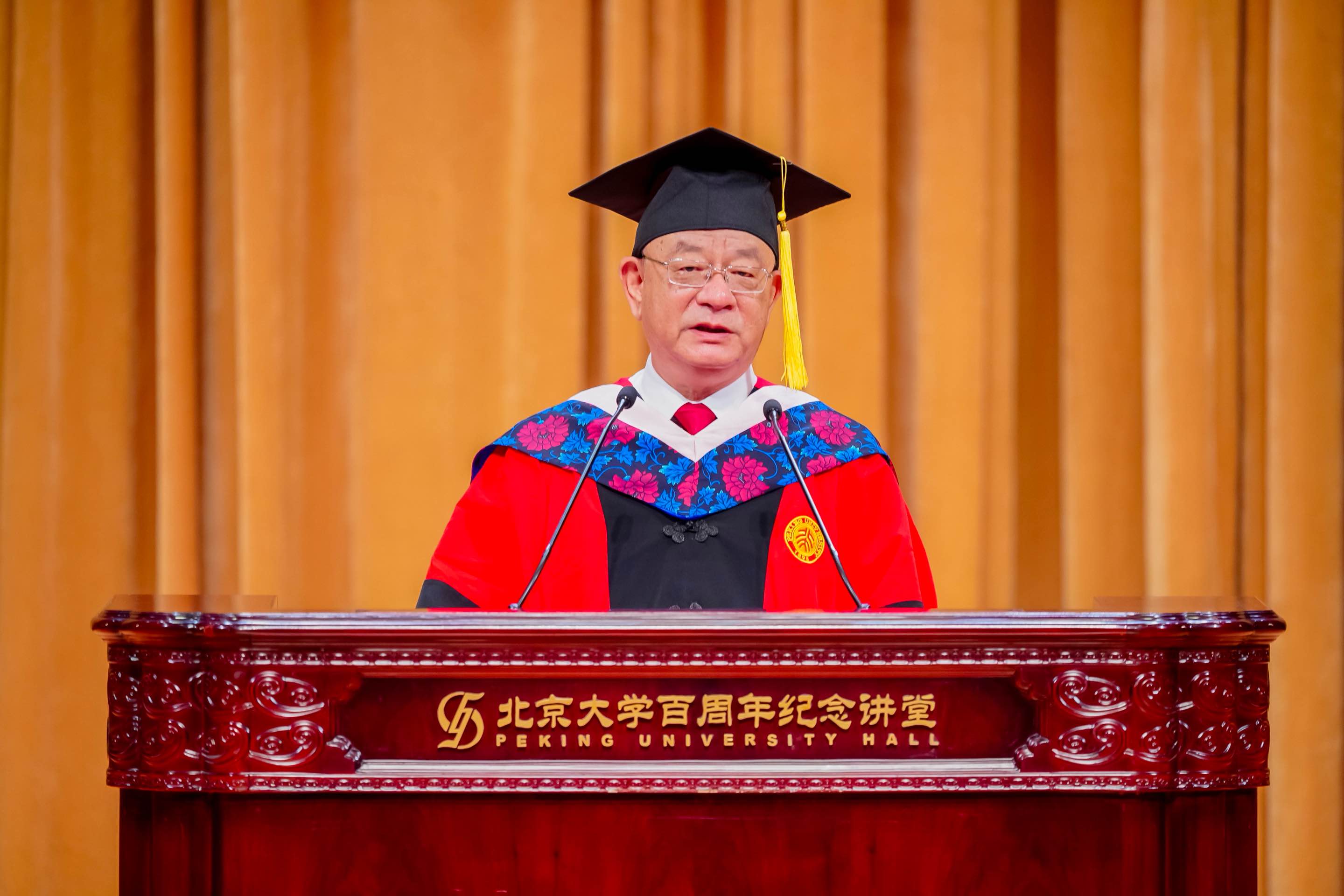
Distinguished faculty members, respected parents and families, and dear graduates,
Good afternoon!
First of all, on behalf of the School, let me extend my heartfelt congratulations to each and every one of you. Congratulations on your graduation and on embarking upon a new chapter in your lives. At the same time, I would also like to express my deepest gratitude to your teachers, mentors, and families, who have devoted so much care and effort to your growth over the years.
Graduation marks an important milestone. In a deeper sense, it signifies your transformation—from one who receives to one who gives, both in identity and in spirit. On this occasion, I would like to leave you with three words: responsibility, self-discipline, and choice.
Let me begin with responsibility.
The Shuowen Jiezi defines the Chinese character ze (责) as “to seek,” suggesting that responsibility is fundamentally about the demands placed upon us to bear and fulfill obligations. As students of international studies, many of you often speak of your deep sense of commitment to the nation and to society. From this day forward, I hope you will truly shoulder the responsibilities of both your country and the wider world.
Mencius wrote:
“Yu, seeing that there were people drowning, felt as though he himself had caused them to drown. Ji, seeing that there were people starving, felt as though he himself had caused them to starve.”
This reflects not only compassion but an extraordinary sense of responsibility. Yu and Hou Ji did not blame themselves for others’ suffering; rather, they regarded it as a call to devote every possible effort to alleviating it.
As students of international relations, can we cultivate the same spirit? Can we say to ourselves, “When there are people trapped in war, it is as though I myself had placed them there”? If we can, our understanding of the world will no longer be that of detached observers commenting from the sidelines, but of individuals who genuinely share in the suffering of others.
Zengzi once said:
“A scholar must be broad-minded and resolute, for his burden is heavy and his journey is long. To take benevolence as one’s responsibility—is this not a heavy burden? To persevere until death—is this not a long journey?”
Here, Zengzi explains both the nature and the duration of responsibility. Its essence is ren—benevolence, or concern for humanity—and its commitment lasts a lifetime. Few words could be more fitting for graduates of international studies. Whatever career you pursue and wherever life may take you, I hope you will always carry this profound sense of mission.
Responsibility exists on many levels. It begins with love for our families, extends to loyalty among friends, grows into service to society, and ultimately encompasses responsibility for humanity as a whole. This progression—from the near to the distant, from the familiar to the universal—raises an important question: what is its underlying logic?
Personally, I agree with Mencius, who wrote:
“Care for one’s family, and thereby extend benevolence to the people; care for the people, and thereby extend compassion to all living things.”
In other words, our love for humanity begins with our love for those closest to us.
A student once asked Wang Yangming why Mencius did not regard Mozi’s doctrine of universal love as true benevolence. Wang’s answer was illuminating. A tree first sends forth buds; from those buds grow the trunk, then the branches and leaves. Without the bud, there can be no tree. Likewise, without love for one’s family, how can one truly love the world? To fulfill our responsibilities toward humanity, we must begin by caring for those around us.
Responsibility, however, is not only about caring for others. It also demands that we hold ourselves accountable.
Jean-Jacques Rousseau described human beings as creatures capable of self-improvement. To be “perfectible” means that we are imperfect, yet capable of becoming better. There is no responsibility where perfection already exists, nor where improvement is impossible. Responsibility belongs uniquely to beings who possess the capacity for moral growth.
This brings me to the second word I wish to discuss today: self-discipline.
In Immanuel Kant’s philosophy, self-discipline means that rational beings legislate moral laws for themselves. We are capable of doing so not only because we possess reason, but because we are free. Self-discipline is therefore the moral expression of human freedom: it is responsibility directed inward.
I have often said that human beings are beings of possibility. Self-discipline is what transforms that possibility into reality.
Although classical Chinese thought does not employ the modern term “self-discipline,” the idea of assuming responsibility for oneself has always stood at the heart of moral cultivation. Zengzi famously reflected upon himself three times each day, offering perhaps the most basic example of self-discipline.
Within the Confucian tradition, the concept that most fully embodies this spirit is shendu—being watchful over oneself even when alone.
The Great Learning teaches:
“The gentleman is always watchful over himself when alone.”
Even in the most private moments, beyond the sight of others, one must continue to uphold one’s principles and remain within the bounds of propriety.
The Doctrine of the Mean develops this idea further:
“The gentleman is cautious where nothing can yet be seen, and apprehensive where nothing can yet be heard… Therefore, the gentleman is watchful over himself when alone.”
What truly concerns the virtuous person is not external judgment, but whether he has honestly examined his own conduct. This, I believe, is the true meaning of self-discipline.
At its core, self-discipline establishes an inner moral order. Once such an order is formed, the noise and distractions of the external world lose their power to shake our convictions.
Of course, this is far from easy. Most of us spend much of our lives caught between self-discipline and external discipline. Confucius remarked that only at the age of seventy could he “follow the desires of his heart without transgressing what was right.” Even he regarded moral freedom as the achievement of a lifetime.
Yet we should not be discouraged. The very struggle between external expectations and inner conviction is itself valuable, for it compels us to reflect, and through reflection, to grow.
Self-discipline matters because the norms governing human conduct ultimately arise from humanity’s collective moral self-governance.
Lu Xun famously wrote:
“There was originally no road upon the earth. As more people walked, a road came into being.”
Allow me to adapt his words:
“There was originally no goodness in the world. As more people believed in goodness, goodness came into being.”
There is no objective moral law as self-evident and immutable as the proposition that one plus one equals two.
Wang Yangming wrote:
“The mind in itself is beyond good and evil. Good and evil arise when intentions are formed. To know good and evil is innate moral knowledge; to do good and remove evil is the investigation of things.”
One way to understand this is that good and evil acquire meaning because human beings recognize them as such. That recognition marks the beginning of conscience. Yet conscience alone is insufficient. We must act upon it.
To be human lies precisely in that decisive moment between knowing and acting. Good and evil are not arbitrary categories; they rest upon deeper understandings of the cosmos and human nature, though those are questions for another occasion. What I wish to emphasize today is simply this: choosing to do good and reject evil ultimately depends upon human decision.
This brings me to the final word: choice.
Choice is not merely a matter of intelligence. It is fundamentally about discernment and sacrifice. In this sense, the ability to choose may itself be among the highest forms of moral virtue.
The difficulty of choice lies not only in having the courage to embrace what is right and reject what is wrong. More often, we face situations in which two worthy values cannot both be realized. Loyalty may conflict with filial devotion; friendship may clash with justice; personal interests may stand in tension with the common good.
In such dilemmas, there are no fixed formulas to follow, nor any guarantee that our decisions will satisfy everyone. Every meaningful choice requires us to relinquish something. To choose one good often means giving up another.
This is the tragic dimension of human life.
Hegel argued that tragedy is not the conflict between good and evil, but the collision between two competing goods.
Such tragedy accompanies every human life.
After leaving this campus, each of you will eventually encounter moments when you must choose between two paths, knowing that whichever you take, you must accept the loss of the other. You may find yourself balancing career and family, ideals and reality, principles and relationships.
The tragedy of choice lies precisely here: it asks us to surrender one part of ourselves in order to preserve another.
I deliberately use the word “tragedy” to remind you that learning to choose also means learning to let go—and preparing to bear the pain that such sacrifice inevitably brings. Those who believe they can have everything may ultimately lose everything.
The three words I have spoken about today—responsibility, self-discipline, and choice—are, in truth, three dimensions of the same human endeavor.
We choose our values. We discipline ourselves according to those values. We assume responsibility on their behalf.
This is what fundamentally distinguishes human beings, for we legislate moral laws for ourselves.
The Doctrine of the Mean teaches that human beings may “assist in the transforming and nourishing powers of Heaven and Earth” and thus “form a triad with Heaven and Earth.” The famous opening lines of Zhang Zai’s Western Inscription likewise proclaim that we should “establish the heart of Heaven and Earth.”
Ultimately, all of this echoes Confucius’ profound observation:
“It is people who enlarge the Way; the Way does not enlarge people.”
Our choices, our self-discipline, and our sense of responsibility transform not only ourselves but also the world in which we live.
During your years at Peking University, many of you have spent four, six, ten, or even more years striving alongside—and sometimes competing with—one another. Much of that was shaped by external expectations.
From this day forward, I hope you will increasingly be guided by self-discipline rather than external pressure. If you must compete, compete with the person you were yesterday.
The Doctrine of the Mean teaches:
“The gentleman acts faithfully according to the position in which he finds himself, without longing for what lies beyond it.”
If you continue to carry a sense of responsibility toward yourselves, toward others, and toward society; if you preserve inner vigilance and self-discipline; if you remain thoughtful and clear-minded whenever you make difficult choices, then wherever life leads you, and whatever challenges you encounter, you will always find your own direction. More importantly, you will become someone worthy of trust and worthy of responsibility.
Finally, I wish all of you the courage to make meaningful choices, the strength to cultivate self-discipline, and the resolve to shoulder responsibility. May you live a life that is uniquely your own—a life as beautiful as poetry and as inspiring as a painting.
Thank you.
Tang Shiqi
June 29, 2026