

ISSN:1671-4709
Latest Issue:Volume 47,Number 2,
April 2026
THE JOURNAL OF INTERNATIONAL STUDIES is a bimonthly academic journal sponsored by Peking University and published by the School of International Studies of Peking University and the Society of China Association of Higher Education. As a leading journal in international studies in China, it is open to contributions by Chinese and foreign scholars and invites submission of academic articles on international relations theories, international security, international political economy, area studies as well as Chinese politics and foreign policy.
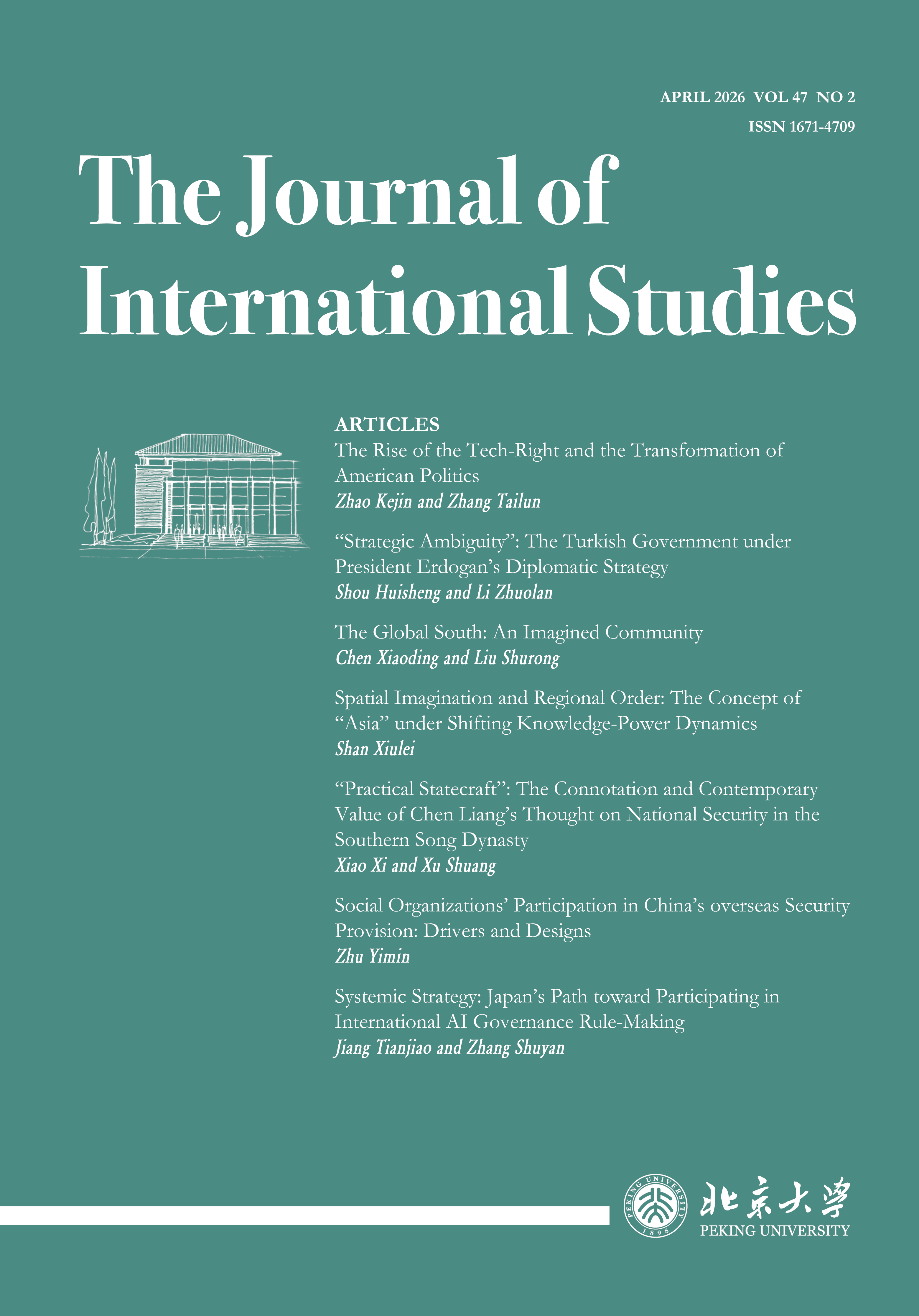
Japan’s overall AI capability ranks in the world’s second tier. Nevertheless, through a structured science and technology diplomacy approach, it has effectively enhanced its international influence in this field by employing three strategies: institutional participation, discourse construction, and practice sharing. At the institutional level, Japan has actively promoted the “alignment” of AI governance principles among the OECD, the G7, and the G20 and has introduced the “Data Free Flow with Trust” (DFFT) framework as a supporting mechanism for AI governance. At the discourse level, Japan prepares draft texts for international AI discussions to highlight its national interests in international rule-making. At the practical level, Japan shares with the international community its governance practices characterized by a “soft law paradigm” and “agile governance,” thereby attracting international recognition. Through the interaction among these three approaches, Japan has shaped its international image as an “active actor” in global AI governance, helping to strengthen its international discursive power.
Constructing a systematic and multi-layered framework for overseas security provision is conducive to advancing national security capacity building. Owing to their resource endowments and professional operational advantages, social organizations are capable of compensating for the shortcomings of China’s overseas security provision in terms of coverage and resource allocation, making them indispensable actors in improving overseas security mechanisms. As for participation advantages, social organizations can, on the one hand, expand the scale of overseas security provision through symbolic capital, social capital, and knowledge capital; on the other hand, they can enhance security provision through social advocacy and professional public services, thereby addressing the limitations of the “government-market” dual structure in terms of capability boundaries and allocation efficiency. Regarding pathway design, social organizations should follow three approaches-integration, linkage, and symbiosis-to constructively embed themselves into the national overseas security governance system, build communication bridges among multiple actors, and promote inclusive benefits for all parties. The Global Environmental Institute’s participation in the protection of China’s overseas investment from 2005 to 2024 demonstrate the feasibility and effectiveness of the above pathway design. Looking ahead, China should incorporate social organizations into the overall planning of its overseas security mechanisms and, through diversified collaborative governance, establish a systematic and efficient overseas security provision system supported by the discipline of national security studies.
The Chinese nation has accumulated rich resources of thought on national security throughout its history. Among these, Chen Liang, a representative figure of the “Yongkang School” in the Southern Song Dynasty, proposed a series of substantive ideas on national security based on his profound insight into the crises of his era. His theory of governance, encapsulated in the maxim “establish the fundamental principles to rectify discipline, and define the grand strategy to enable adaptive actions,” was founded on an understanding of the systematic security crises in the early Southern Song, emphasizing the foundational role of core principles and overarching strategy. His view of rule of law, expressed as “acting with utmost impartiality in accordance with the times,” originated from reflection on and critique of the limitations of the Song Dynasty’s legal institutions, embodying the requirement to unify principled rigor with flexibility. His practical character, centered on the idea that “Tao is manifested in Shi (concrete affairs)”, was fully demonstrated in his famous debate with Zhu Xi on “The Kingly Way” versus “The Hegemonic Way” and Yi (Righteousness) versus Li (Utility), which were reflected in his ontology of “the unity of Tao and Shi”, his methodology advocating for “the concurrent practice of Yi and Li and the integrated application of the Kingly Way and the Hegemonic Way,” and his subjectivity characterized by “responsibility and broad-mindedness.” Chen Liang’s thought on national security, underpinned by his “Practical Statecraft” provides profound historical and cultural support for constructing an autonomous knowledge system of Chinese national security studies.
Space has never been a neutral geographical container; rather, it is a political field continuously produced and reshaped, long bearing the weight of external naming, colonial discourse, and geopolitical projections. “Asia” is precisely such a regional concept that has been constantly constructed through the interplay of knowledge and power. Historically, the concept of the “Orient” emerged from a Eurocentric colonial perspective, representing the West’s othering imagination of the non-Western world during its global expansion. The rise of the “Indo-Pacific” concept reflects the United States’ hegemonic attempt to reshape its alliance system and strategic order through geopolitical positioning. In contrast, the contemporary reproduction of the concept of “Asia” embodies the awakening of regional autonomy and civilizational subjectivity. Driven by the rise of civilizational nations like China and anchored by regional cooperation platforms such as ASEAN and the Boao Forum For Asia, the concept of “Asia” has gradually transcended its colonial and hegemonic logic, evolving into a vision of order characterized by inclusivity and openness. In this sense, the “Asia” concept constitutes both a discursive reflection on and a corrective to Orientalism and a recontextualization of the “Indo-Pacific” framework. It is no longer a named “other” but a subject redefining itself within the global knowledge system. The practical experiences and civilizational resources embedded in the “Asia” concept are driving a shift in thought beyond Western modernity, pointing toward a more inclusive and autonomous order.
As an imagined community, the Global South is a limited, mutually recognized association based on shared historical memory. Incremental power, common institutions, and identity, in the field of international relations, are the main types of community origins. Nevertheless, they are far from enough to explain the generation and development of the Global South. The historical narrative construction, identity positioning, and Southern discourse articulation emphasize the imagined unity within this collective, yet real differences in internal agency still exist and need to be examined. This article holds that the structure of the system both decides the imaginary boundaries and limits the power distribution of the Global South community, thus forming a power distribution hierarchy. This study identifies four types of agencies generated by preference differences under structural selection and role positioning in the socialization process. They are confrontational suppression, competitive coexistence, cooperative coexistence, and vision-oriented dependence. This categorization is further substantiated through case studies of India, Brazil, Rwanda, and the Shanghai Cooperation Organization, respectively. At present, the Global South community urgently needs to effectively leverage the leadership of major Southern powers, activate the participation effectiveness of small and medium-sized countries and draw on the experiences and institutional models of multilateral cooperative mechanisms. As an essential member of this community, China can help consolidate the Global South community by transcending zero-sum thinking, strengthening institutional resilience, and fostering a stronger sense of shared identity.
Against the wave of accelerating global transformation, a new political force known as the tech-right has rapidly emerged on the U.S. social and political stage. Driven by the advancement of economic globalization, digitalization, and AI transformation, this force is grounded in accelerationism as its philosophical foundation, guided by right-wing conservatism as its dominant ideology, and adheres to anti-establishment and anti-system political logic. It is now spearheading a politically transformative shift in the U.S. of historic significance. In essence, this transformation represents a political reckoning with progressive America since the era of Roosevelt. By engaging in U.S. party politics, electoral politics, and governance, it has ushered in a new era dominated by right-wing conservatism. To grasp the political potential of the tech-right, one must examine its social foundation and ecological reason from the perspective of the global transformation ecosystem in which American politics operates. From the standpoint of ecological institutionalism, the historical significance of the tech-right’s rise lies in its response to the essential changes in U.S. modes of production during the digital and AI era. These changes will lead to substantial transformations in the U.S. constitutional structure over an extended period, driving the nation from a progressive era dominated by liberal democratic consensus into a conservative era led by an “America First” consensus. It thus pioneers a new future for American politics.